Free reading · Chapters One & Two
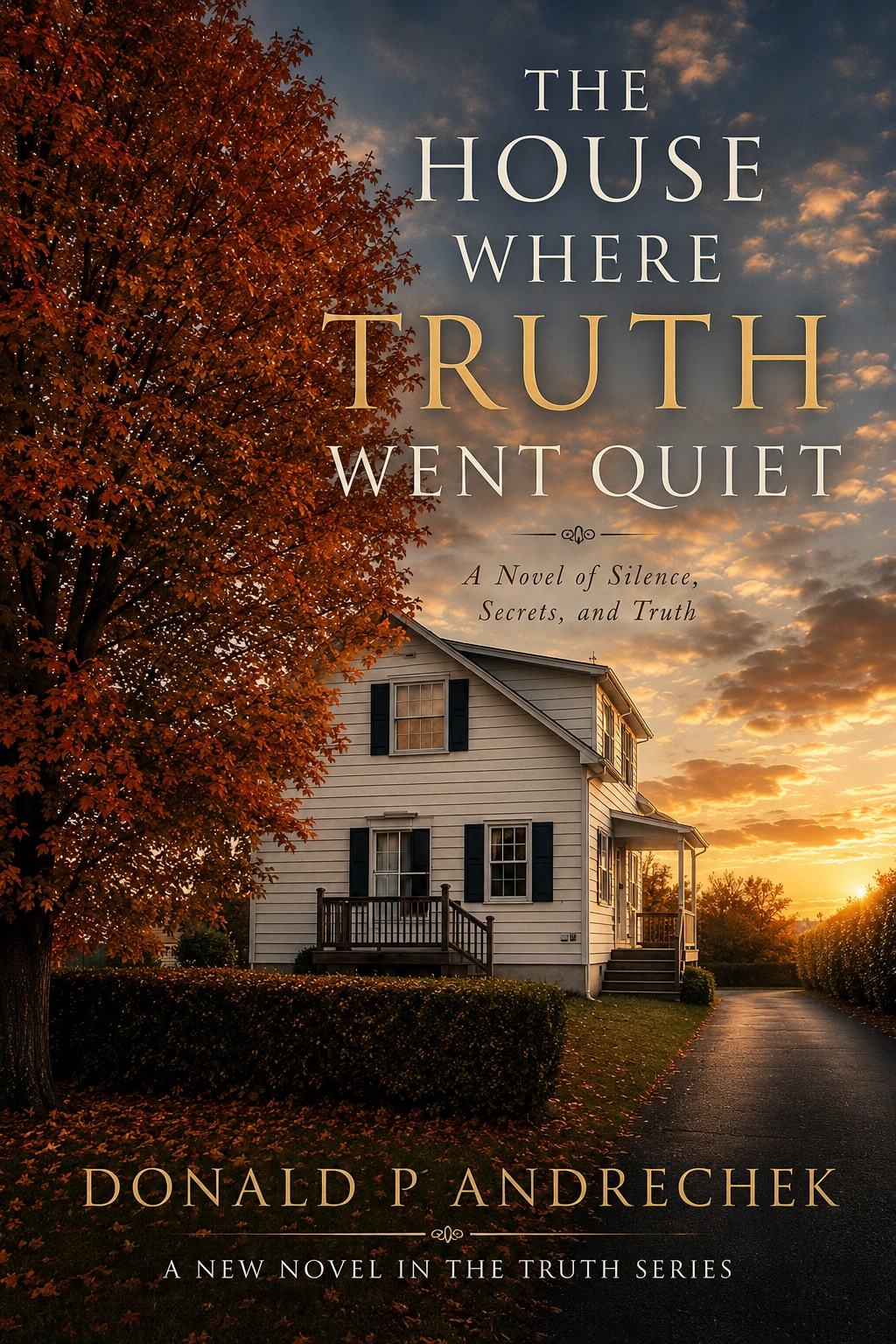
The House Where Truth Went Quiet
A Story About Love, Silence, and the Cost of Keeping a Family Together
Enter your first name and email below and Chapters 1 and 2 open immediately. Reader List emails are optional and separate.
Full novel releases October 6, 2026.
Your free preview
Get Chapters 1 and 2 now.
Enter your first name and email. The chapters open immediately on this page, and you can download the PDF too.
Your preview is open
Chapters 1 and 2 are ready.
You can read below or keep the PDF on your device.
CHAPTER ONE
The Letter
On the morning the town came to honour her husband, Eleanor Mercer received a letter from the son she had helped erase.
It was waiting in the black mailbox at the end of the drive, held upright between a grocery flyer and an envelope from the power company. Eleanor knew the handwriting before she touched it. The capital E began with one firm vertical stroke. The final r in Mercer fell away from the other letters, as though it had already decided to leave.
For several seconds she stood in the pale September cold with one hand inside the mailbox and the other holding the speech she was meant to give at noon.
The speech had been printed on thick cream paper by the school secretary. On its first page, beneath the crest of Willowridge Secondary School, were the words:
THOMAS MERCER MEMORIAL AUDITORIUM DEDICATION CEREMONY
The town had been preparing for six months. Former students were driving in from Ottawa, Arnprior, Renfrew and communities across the Ottawa Valley. There would be a choir, a brass plaque, coffee in silver urns, and a display of photographs showing Tom through the years. Tom with the debate team. Tom planting a spruce on Earth Day. Tom kneeling beside a boy who had won the provincial science prize. In every photograph he was leaning toward somebody else’s future.
Eleanor took the letter from the mailbox.
There was no return address. Jonah had written only her name and the Bell Street house where he had not slept for twenty seven years.
The paper in her hand was light. What it carried was not.
She looked toward the road. It ran east between harvested fields, empty except for a grain truck moving far off in its own cloud. The town had not yet begun ringing her telephone to make sure she was dressed, fed, collected, grateful. For the moment she had the road, the cold, and the choice to put Jonah’s letter unopened beneath the grocery flyer and walk back inside.
She had made larger choices with less hesitation.
Eleanor slipped the speech under her arm and opened the envelope with her thumb.
Mom,
That word stopped her. Jonah had not called her Mom since the night he left. In the two letters he had sent during the first year, he had begun with Eleanor. After that, nothing.
She continued.
Anna called me yesterday. She asked why I left. I told her the answer belongs to you before it belongs to me.
I will be at the school at noon. If you want them to hear it from you, tell them before I arrive.
I am not coming to ruin the ceremony. I am coming because I am done being the reason our family gives for what happened.
Jonah
Eleanor read the letter twice. Then a third time, more slowly, as if one of the sentences might change out of pity.
The sun had cleared the neighbour’s poplars. Light caught in the chrome lip of the mailbox and made her squint. She folded Jonah’s letter along its existing crease, returned it to the envelope, and carried everything into the house.
The kitchen smelled of coffee she had forgotten to drink. On the table lay the navy dress Anna had chosen for her, a string of pearls in a white box, and three pages of kind sentences about Thomas.
Eleanor set Jonah’s letter beside them.
For the past week she had practised the speech each morning. Thomas believed education should enlarge the choices a child could see. Thomas saw possibility in every student. Thomas taught us that courage begins when we trust the life waiting for us.
She had crossed out the word every once. The secretary had put it back.
The telephone rang.
Eleanor stayed where she was.
It rang four times, paused, and began again. On the counter, the machine announced Anna’s name in its flat mechanical voice.
Eleanor picked up.
“You found it,” Anna said.
There was no good answer, so Eleanor gave the smallest one. “Yes.”
Anna let out a breath. In the background a cupboard door closed, then a child asked where his other shoe was. Eleanor pictured her daughter standing in the narrow kitchen across town, telephone pressed to one ear, pinning her hair with the other hand while Eli and Sophie circled her in their ceremony clothes.
“Did you read it?”
“Yes.”
“Is he coming?”
Eleanor checked the wall clock. It was eight seventeen.
“He says he is.”
Anna did not answer.
“Mom, I did not call him to hurt you.”
“I understand.”
“I was clearing the study. You asked me to start with the books.”
“I know what I asked.”
“Then you know I wasn’t looking for anything.”
Eleanor put her free hand on the back of a chair. The wood was worn smooth where Tom had gripped it before sitting each morning.
“What exactly did you find?”
Anna waited before answering.
“We should talk in person.”
“You called Jonah in person?”
The unfairness of the question landed before Eleanor could take it back.
Anna’s voice cooled. “I called my brother.”
Eleanor closed her eyes.
In all the years Jonah had been gone, they had never stopped calling him that. My brother. My son. Our Jonah. The words remained in the family after the person had been removed, like labels on empty drawers.
“I’m sorry,” Eleanor said.
“Are you?”
Anna did not raise her voice. She never had to.
“About what I just said, yes.”
“And the rest?”
Eleanor watched steam fade above the coffee cup.
“Come early,” she said. “Come without Micah.”
“Micah is speaking at the ceremony.”
“Then come before he has to be there.”
“Why without him?”
Eleanor had once believed that keeping two people apart could keep pain from multiplying. She had believed many things that were useful at the time.
“Because I need to tell one of you first.”
Anna made a small sound, not quite disbelief and not quite anger.
“You still think choosing who gets the truth first is the same as telling it.”
The line went quiet.
Eleanor held the telephone until the machine gave a soft tone and showed the call had ended. Then she returned the receiver to its cradle.
On the table, the pearls shone with the mild innocence of objects.
Tom had given them to her on their thirtieth anniversary. He had arranged for the children to meet them at a restaurant in the city, but Jonah had not come. At dessert Micah raised a glass and said their parents had taught him what loyalty looked like. Anna cried. Tom looked down at his plate with the modest expression he wore whenever people praised him for a virtue that had cost someone else more than it cost him.
Eleanor had loved him then.
She loved him now.
That was the trouble no confession could simplify.
The study door stood at the end of the hall.
Since Tom’s death eleven months earlier, Eleanor had entered only to close the window after a storm. His reading glasses remained open on the desk blotter. A yellow pencil lay beside them, sharpened to the exact length he preferred. On the windowsill sat a clay bird made by a student whose name Eleanor had forgotten and Tom never had.
Anna had begun sorting the shelves two days ago. She worked for an hour before Eleanor told her the dust was upsetting her lungs. Neither woman mentioned that Eleanor had not coughed.
Now Eleanor went to the china cabinet and opened the shallow drawer beneath the linens. Under a stack of birthday candles lay a brass key.
Tom used to carry it on his ring. After he died, Eleanor had moved it from the dish in the bedroom to the sewing basket, then to the blue vase, then finally to the drawer beneath the candles. Each hiding place had lasted until she needed something nearby.
She took the key to the study.
The lock resisted. Eleanor turned the key harder, and the mechanism gave with a sound too small for all that followed.
Tom was everywhere in the room.
It was in the hollow of the leather chair and in the pale spaces on the wall where his university degrees had hung before the school borrowed them for the memorial display. It was in the wool jacket behind the door, the one Eleanor had been unable to give away because a receipt remained in its pocket from the last ordinary day of their marriage.
She stood on the threshold and waited for grief.
What came instead was the old question: what would Tom allow?
Eleanor stepped inside.
The desk had three drawers on each side. Anna had emptied the top two and left their contents in careful stacks. Pens. School pins. Receipts. Letters from former students. A photograph of Micah at his university graduation. A photograph of Anna holding newborn Eli. No photograph of Jonah.
Eleanor opened the lower right drawer.
Empty.
She knelt, ignoring the complaint in her knees, and ran her fingers along the back panel. The false bottom was still there. Tom had built it himself after a burglary on Cedar Street frightened half the town. He kept passports, insurance papers, and the house deed beneath it.
For twenty seven years, he had also kept a blue folder.
Eleanor lifted the panel.
The passports were there, both expired. So was the deed, sealed in plastic, and the small envelope containing Tom’s father’s watch.
The blue folder was gone.
Eleanor sat back on her heels.
Anna had found it.
A hard knock sounded at the front door.
Eleanor lowered the panel and stood too quickly. The room tipped. She caught the desk, knocking Tom’s glasses to the floor.
One lens cracked.
The sight of it released a feeling so sharp that she nearly laughed. Eleven months protecting a dead man’s spectacles, and they broke on the morning she might finally stop protecting him.
The knock came again.
“Ellie?” a woman called through the front door. “It’s Mara. I have enough muffins to feed the graduating class of nineteen eighty four.”
Eleanor picked up the glasses and placed them on the blotter with the crack facing down.
Mara Vale stood on the step carrying a covered basket and wearing the green coat she had owned since before either of them admitted to grey hair. At sixty eight, Mara was narrow and quick, with the steady eyes of someone who had spent forty years hearing what people said when they were trying not to say something else.
She glanced once at Eleanor and stopped smiling.
“What happened?”
“Nothing.”
Mara lifted the basket. “Then these are for nothing. I put cinnamon on half.”
Eleanor stepped aside.
Mara had lived across the road for fourteen years. She had sat beside Eleanor at the hospital while Tom’s final hours narrowed around them. She knew where the spare key was, which cupboard held the tea, and how long Eleanor could be trusted alone before solitude turned from medicine into accomplice.
She set the basket on the kitchen counter.
“Anna asked me to make sure you ate.”
“Anna asks everyone to manage me.”
“Only the ones who accept payment in coffee.”
Mara removed two mugs from the cupboard as though permission were unnecessary. Eleanor was grateful and irritated in equal measure, a feeling that had come to define most kindness since Tom died.
“You’re not dressed,” Mara said.
“The ceremony is hours away.”
“The school wants you there at eleven.”
“I know when they want me.”
Mara poured out the cold coffee, rinsed the pot, and began another. She was waiting Eleanor out. Eleanor knew it.
It almost worked.
“A letter came,” Eleanor said.
Mara measured coffee into the filter. “From whom?”
Eleanor looked back at the envelope on the table.
Mara followed her gaze and went still.
“Jonah?”
Eleanor nodded.
“Is he all right?”
Of all the questions Eleanor had rehearsed, that was not one of them.
Is he all right?
“I don’t know.”
“What does he say?”
“He is coming.”
Mara put the scoop down.
“Today?”
“At noon.”
Outside, a truck changed gears on the highway. The coffee machine began its low sputter.
Mara sat opposite her.
“Does Anna know?”
“Anna is the reason he wrote.”
“And Micah?”
“Not yet.”
Mara glanced toward the open study door, then back at Eleanor. Whatever she was about to ask, she kept it to herself.
Eleanor wished she had asked.
“The town has invited four hundred people to praise Tom,” Eleanor said. “Jonah has chosen noon to return.”
“You think he chose the ceremony?”
“He knows about it.”
“That isn’t what I asked.”
Eleanor pushed the envelope away. “He says he isn’t coming to ruin anything.”
“Do you believe him?”
“I don’t know him.”
Mara’s answer was gentle. “You knew him.”
Eleanor rose and crossed to the window. Beyond the glass, her yard sloped to a row of lilacs Tom had planted after their tenth anniversary. In spring they flowered so heavily that branches bowed to the ground. He used to cut armfuls for the school office.
“He was twenty three when he left,” Eleanor said. “He is fifty now.”
“Then both things are true.”
Eleanor turned. “What things?”
“You knew the young man. You do not know the man coming home.”
Home. Eleanor almost corrected her.
“He has a talent for arriving at the moment he can cause the most damage.”
Mara studied her. “Did he have that talent before he left?”
The coffee machine clicked off.
Eleanor lifted the pot and filled both mugs. She kept her back to Mara.
“There are matters inside a family that cannot be explained from the outside.”
“Yes.”
“You say that as if you agree.”
“I do. I also know families use that sentence when they are afraid an explanation will make perfect sense.”
Eleanor set the pot down harder than she intended.
Mara added milk to her coffee. “You don’t have to tell me.”
“Thank you.”
“I cannot tell whether you are angry that he is coming or scared that he actually will.”
“I am neither.”
“Then eat a muffin.”
Eleanor almost smiled. Mara pushed the basket toward her, and for a few minutes they spoke of practical things. The choir would sing before the unveiling. The mayor had been told to keep his remarks under ten minutes, which meant he would speak for twenty. Micah’s family would sit in the front row. Anna had printed Eleanor’s speech in larger type in case her glasses troubled her.
The cracked pair in the study seemed to listen.
“I could call the school,” Mara said. “Tell them you are unwell.”
Eleanor shook her head.
“You look unwell.”
“I look old.”
“That too.”
This time Eleanor did smile.
Mara finished her coffee and stood. At the front door she buttoned her coat, then reached for Eleanor’s hand.
“Tom mattered to this town. You still do not have to stand in front of four hundred people and pretend nothing is wrong.”
Eleanor withdrew her hand.
“He was a good man.”
“I know.”
“You say that as if there is a second sentence.”
“With you, there usually is.”
Mara left.
Eleanor watched her cross the road, green coat bright against the stubbled fields. Then she closed the door and returned to the study.
Sunlight had reached the desk. Dust moved above it in slow, visible currents. The crack in Tom’s glasses had become a white line through the right lens.
Eleanor opened the drawers again, though she knew the folder was gone. She searched behind books, inside the file cabinet, and through the cupboard beneath the window. She found tax records, warranty papers, a stack of birthday cards Tom had bought and forgotten to send.
In the bottom of the file cabinet lay a wooden model of a house.
Jonah had made it at sixteen from scraps of cedar. It was no larger than a bread box, but every window opened. The roof lifted to show two floors, a central stair, and rooms measured to scale. He had even carved tiny kitchen cupboards and a narrow desk for the room he wanted as his own.
Tom had brought the model to school to show the drafting teacher. The following autumn Jonah began spending Saturdays in the study, working on an application to St. Anselm School of Architecture in Montreal. He drew until the edge of his hand shone with graphite. Eleanor would bring him apple slices and stand behind his chair, astonished that a boy raised among flat fields could imagine buildings with courtyards, bridges, and walls curved to gather light.
St. Anselm had offered one full scholarship to a student from eastern Ontario.
Jonah won it.
Eleanor sat on the floor with the small house in her lap.
At fifty, she had believed a family survived by making sure nobody left at the wrong time. Anna was fourteen. Micah was seventeen and already drifting toward friends who treated every limit as an insult. Tom was preparing for his first year as principal. Eleanor’s mother had moved into the spare room after a stroke, and every day had become a corridor with somebody calling from each end.
Jonah was the reliable one.
That phrase had blessed him in public and sentenced him in private.
He worked evenings at the hardware store. He took his grandmother to appointments. He repaired the porch and made supper on the nights Eleanor could not manage it. When the letter from St. Anselm arrived, the family celebrated with a cake from the bakery. Tom told everyone at church that his eldest son would design buildings people crossed oceans to see.
Three weeks later, Tom mailed a reply declining the scholarship.
Eleanor knew because she had asked him to.
Not at first. At first she had asked Jonah to wait one year. Then one term. Then until Micah finished school and Anna no longer needed rides and her mother could be placed somewhere that did not smell like bleach and surrender.
Jonah listened. He had his father’s stillness, though not his father’s patience for being admired.
“You keep describing when I can go,” he said. “You have not asked if I will.”
Eleanor told him families made sacrifices.
“Families,” Jonah said, “or the person who always says yes?”
He refused to surrender the place.
Eleanor cried in the kitchen after midnight, quietly at first, then with the exhaustion of a woman who had confused being needed with being loved. She told Tom that Jonah had no idea what his leaving would do to them.
Tom went into the study.
The next morning he said the matter was settled.
Eleanor left the question alone.
That omission had become the hinge of her life.
She learned the answer four months later when Jonah came home holding the blue folder. By then the scholarship had been given to someone else. The term had begun. The family had already accepted Jonah’s continued presence as if his future had simply changed its mind.
Eleanor could still see him in the doorway of the kitchen, snow melting on his shoulders, the forged reply trembling in his hand.
His voice stayed level.
He asked his father one question.
“Did she know?”
Tom answered before Eleanor could.
“Your mother needed you.”
Jonah met her eyes.
There were moments when a life divided so quietly that no one in the next room heard it happen.
Eleanor lowered the wooden house to the floor.
The telephone rang again.
This time she answered before the second ring.
“Mom?” Anna said.
Eleanor looked toward the front window. Mara had reached her own house. The road remained empty.
“Come now,” Eleanor said.
“I can’t leave the children alone.”
“Bring them.”
“You said without Micah.”
“The children are not Micah.”
Anna exhaled. “He called while we were talking. He wants to know why you aren’t answering your mobile.”
Eleanor had left it charging beside her bed.
“Do not tell him Jonah is coming.”
“You don’t get to ask me for silence today.”
Anna said it so softly that Eleanor had to listen harder.
Eleanor placed the little house on Tom’s desk. Through its open windows she could see the room on the other side.
“What did you tell Jonah?”
“That I found two letters in Dad’s blue folder. One was from St. Anselm offering the scholarship. The other was a copy of Jonah’s reply.”
“It was not his reply.”
“Yes.”
Eleanor pressed her fingers to the cracked lens of Tom’s glasses.
Anna continued. “The signature did not look right. I called Jonah and asked if Dad had written it.”
“What did he say?”
“He asked whether you were in the room with me.”
Eleanor could hear Sophie in the background singing to herself, making one clear line of melody from the names of things she could see.
“Then he said I should ask you what happened.”
“And did you?”
“I am asking now.”
On the wall facing the desk hung a framed photograph the school had not borrowed. Tom stood beneath the old auditorium sign on his final day as principal. Students crowded around him, their faces lifted toward the camera. Across the bottom of the mat, in silver ink, someone had written: Thank you for believing our lives belonged to us.
Eleanor had read that sentence for years without understanding its accusation.
“Your father answered for Jonah,” she said.
The line was silent.
Eleanor continued before courage could disguise itself as timing.
“He wrote to the school and gave up Jonah’s place.”
“Why would Dad do that?”
“Because I asked Jonah to stay.”
“That isn’t what I asked.”
Eleanor closed her eyes.
“Because when Jonah said no, I went to your father. I told him this family would fall apart if Jonah left.”
Anna’s voice changed. It became younger, though she was forty one. “Did you know Dad sent the letter?”
Eleanor had spent twenty seven years avoiding the plain answer. There was no use softening it now.
“Not until afterward,” she said. “Not until it was too late to stop him.”
“But you knew before Jonah found out.”
Eleanor opened her eyes.
This was the part she had revised most often. In some versions she learned on the night of the confrontation. In others Tom confessed only after Jonah left. Once, during a winter when she had almost called Jonah, she convinced herself that she had never known at all.
Memory had not betrayed her. She had employed it.
“Yes,” she said.
Anna began to cry without making a sound. Eleanor knew only because her daughter’s breathing changed.
“Why didn’t you tell him?”
Eleanor looked past Anna to the speech on the kitchen table, visible through the open study door. Three pages about courage.
“I was afraid.”
“Of Dad?”
“Of what would happen to all of us.”
“So you let it happen to Jonah.”
Eleanor sat in Tom’s chair.
“Yes.”
Anna did not move.
The walls remained. Morning light rested on the books. A car passed outside with music playing. Somewhere in town, four hundred chairs were being set in rows beneath her husband’s name.
“Anna,” Eleanor said.
Her daughter remained silent.
“Tell Micah to come here.”
“What about the ceremony?”
Eleanor picked up Jonah’s letter.
“Before the town tells the story of your father’s life,” she said, “our family is going to tell the part we made Jonah pay for.”
CHAPTER TWO
What The Folder Kept
A little after nine, Anna carried the blue folder into the Bell Street house as if it contained something that might spill.
Eli entered ahead of her with one shoelace undone. Sophie followed in a pale yellow dress and held a small plastic horse by its hind legs. Neither child spoke until Eleanor closed the door.
Then Sophie studied her grandmother’s housecoat.
“You are not ready.”
“I know.”
“Mom said we were late.”
“Being late does not make Grandma ready,” Eli said.
Anna placed the folder on the narrow hall table. “Take your things into the living room. Do not go into Grandpa’s study.”
“Why?” Sophie asked.
“Because I said so.”
Sophie considered that an invitation. Anna caught her shoulder before she could turn toward the open study door.
“Living room. Please.”
The children went. Eli stepped on his loose lace and struck the door frame with one shoulder. He blamed the frame. Sophie said he had stepped on himself.
Their voices continued beyond the hall.
Eleanor rested one hand beside the folder.
Its blue cover was faded along the edges. Tom had used it for insurance papers before the scholarship arrived. A white label remained near the top, though whatever he had written there had been scraped away. Anna had closed it with a black elastic band that did not belong to it.
“Where did you get that?” Eleanor asked.
Anna stared at her.
Eleanor heard how foolish it sounded. She knew exactly where the folder had been.
“I mean, when did you take it?”
“Yesterday. I told you I was sorting the study.”
“You said you found two letters.”
“I found a folder. The letters were inside.”
“Did you remove anything?”
Anna’s hand tightened around her handbag strap. “Before we do this, decide whether I am your daughter or a person you suspect of stealing from you.”
“I did not say you stole anything.”
“You asked whether I removed anything from a hidden folder containing a forged letter.”
Eleanor heard the difference and disliked it because it was real.
“I am sorry,” she said.
Anna looked toward the living room. Eli had turned on the television without sound. Sophie was making the plastic horse climb the arm of the sofa.
“Mara said she would take them,” Eleanor said.
“I brought them because you told me to.”
“I know.”
“You keep saying that.”
The front door opened before Eleanor answered.
Mara entered with no coat and a dish towel over one shoulder. She had crossed the road in slippers that were not meant for gravel.
“I brought a puzzle and two pencils,” she said. “The children can stay with me until you are finished.”
Eli appeared at the living room door. “What kind of puzzle?”
“A lighthouse. One thousand pieces.”
“That sounds terrible.”
“It may be.”
Sophie came beside him. “Can the horse come?”
“Yes, but it stays off the table.”
Mara’s gaze settled on the blue folder. The ease left her face. She had sat beside Tom while he died and had spent eleven months helping Eleanor preserve the life around his absence. Whatever was inside the folder, she let Eleanor choose whether to reveal it.
Anna stayed still.
“They are supposed to be at the ceremony,” she said.
“There is time,” Mara replied.
“I do not want them passed around because the adults cannot manage a conversation.”
Mara nodded once. “Neither do I. I am asking because they should not have to learn through a wall why their uncle disappeared. My kitchen is across the road. You decide.”
Anna faced Eleanor.
Eleanor resisted the urge to decide for her.
“What do you want to do?” she asked.
Anna rubbed the bridge of her nose. She had not slept. A small grey mark darkened the cuff of her cream sweater, as though she had leaned against the car before the morning had properly begun.
“Go with Mara,” she told the children. “Stay in her house or yard. Do not cross the road alone. I will come for you.”
“Before the ceremony?” Eli asked.
“Yes.”
Sophie raised the horse. “Does Uncle Jonah like horses?”
No adult answered quickly enough.
“I cannot answer that,” Anna said.
“You said he was coming.”
“He is.”
“Then I can ask him.”
Mara opened the door. Cold air entered around her slippers.
“You can ask him after you have helped me find the lighthouse roof.”
The children crossed the road with Mara between them. Sophie glanced back twice. Eli kept walking. Eleanor watched until Mara’s door closed.
Anna returned to the hall table and lifted the folder.
“Kitchen or study?”
Eleanor looked down the hall. The study door remained open. Morning light lay across the carpet and stopped at the threshold.
“Kitchen.”
“Why?”
“Because your father is too present in the other room.”
“He is present in this folder.”
“I know.”
Anna’s mouth tightened again, but she carried it to the kitchen.
The navy dress still lay on the table. The pearls remained in their white box. Jonah’s letter rested beside the speech, its envelope turned so his handwriting faced down.
Anna moved the dress to the back of a chair. She placed the blue folder in the centre of the table and removed the elastic band.
The first page was the offer from St. Anselm School of Architecture.
Eleanor had not touched it in twenty seven years. The crest at the top was darker than she remembered. Beneath it, a dean whose name meant nothing to her now had written that Jonah’s portfolio showed unusual spatial imagination, discipline, and concern for the people who would live inside what he designed.
The scholarship covered tuition. A second paragraph offered a small residence allowance and paid work in the drafting studio.
Eleanor read that paragraph twice.
“Did you know about the residence money?” Anna asked.
“I do not remember.”
“It is in the letter.”
“I know where it is. I do not remember what I understood then.”
“You understood enough to celebrate.”
Eleanor checked the date. July 3, 1984.
The bakery cake had been white with blue piping. Tom had asked the woman behind the counter to draw a building on it. She had made something that looked like a courthouse with six crooked windows. Jonah laughed and ate the corner holding the front steps.
“We were proud of him,” Eleanor said.
“That did not help him.”
“No.”
Anna turned to the second page.
The reply had been typed on plain paper.
Dear Dean Carrow,
Thank you for the honour of admission and for the scholarship offered to me. After careful consideration, I must decline. My responsibilities at home make leaving Ontario impossible at this time. I am grateful for your confidence and regret any inconvenience caused by my decision.
Sincerely,
Jonah Mercer
The signature sloped forward. Tom had captured the long first stroke of the J and the narrow opening in the M. He had missed the way Jonah lifted his pen before the last two letters of Mercer. Eleanor could see that now. She did not know whether she would have seen it then.
Anna touched the bottom of the page without touching the name.
“When did you first see this exact page?”
“The night Jonah found the folder.”
Anna looked up. “You said you knew before he did.”
“I knew your father had answered the school. I had not seen the signature.”
“How long before?”
Eleanor looked toward the clock. It was nine twenty three. The second hand moved over the face with a soft mechanical tick Tom used to complain he could hear from the living room.
“I am trying to remember.”
“You have had twenty seven years.”
“That does not make the day clearer.”
“Then begin with what you do remember.”
Eleanor pulled out a chair and sat.
“Your father told me the matter was settled the morning after I went to him. He did not say what he had done. I did not ask.”
“That was in the study?”
“In the kitchen. He came down before six.”
“And then?”
“Several days passed. Maybe a week.”
“Several or seven?”
“Anna.”
“A week is not a small detail when he could still have called the school.”
Eleanor pressed both palms against the table. The wood was cool.
“It was six days,” she said.
The number came with a Thursday she had forgotten she remembered. Her mother’s prescription had been waiting at the pharmacy, and rain had dried in dark marks on Tom’s coat.
Tom had returned from the school carrying his briefcase and a roll of drawings for the new science rooms. Eleanor’s mother was asleep. Micah and Anna were outside. Jonah had gone to work at the hardware store.
Tom told her he had written to St. Anselm and declined the place.
“I asked whether Jonah had agreed,” Eleanor said.
“What did Dad say?”
“He said agreement was no longer the question.”
Anna’s face became still.
“What did you think he had sent?”
“A letter from us. From the family. I did not let myself imagine the rest.”
“But you knew the school had been told Jonah was not coming.”
“Yes.”
“What else did Dad say?”
Eleanor remembered Tom placing his briefcase beside the door. He had been tired and annoyed about a teacher who arrived late to summer planning.
He said Jonah was angry and would not think past leaving. He said the school would not hold the scholarship, and once the place was gone, the argument would be over. Then they could help Jonah make another plan.
“He said it was done,” Eleanor replied.
“That is not all he said.”
“No.”
“Then tell me the rest.”
Eleanor began, stopped, then told her.
Anna listened without interrupting. That was worse than anger. The room filled with the refrigerator hum, the clock, and the faint scrape of a truck changing gears on the highway.
“Did you believe him?” Anna asked.
“I wanted to.”
“That is a different answer.”
“At the time, it felt like one.”
“Did you call the school?”
“No.”
“Did you tell Jonah?”
“No.”
“Did you ask whether the scholarship could be restored?”
“No.”
Anna looked down at the offer letter.
“Six days.”
Eleanor remained silent.
“The term had not started. He had not lost it yet.”
“I do not know that.”
“You did not find out.”
“No.”
Anna stood so quickly the chair legs struck the floor.
“You keep describing ignorance as if it happened to you.”
Eleanor had no answer ready.
“I was exhausted,” she said. “Your grandmother needed help with everything. Your father was beginning the principal’s job. Micah was failing courses. You were fourteen.”
“And Jonah could manage.”
“Yes.”
“So you chose the one who could cope.”
Eleanor touched the scholarship offer with one finger. “Yes.”
Eleanor heard the smallness of her own yes and stopped trying to hide inside the list.
A knock sounded at the front door.
Neither woman moved.
A second knock came, followed by the sound of a key against the lock.
Micah entered carrying a garment bag and a stack of white cards held together by a brass clip. He wore dark trousers, a white shirt, and no tie. His hair was still damp from the shower.
“Why is the door locked?”
He saw Anna first, then the folder.
“What happened?”
Eleanor rose.
Micah took in the navy dress over the chair and the unopened pearls. His eyes returned to the blue folder.
“Is Mom ill?”
“No,” Anna said.
“Then why did you tell me to come immediately? Ruth has changed the order of the speeches twice, and the mayor has added a story that takes six minutes to tell badly.”
Ruth Calder, Willowridge’s principal, had spent six months arranging every minute of the dedication.
He put the garment bag over the back of the nearest chair.
“What is that?”
Anna held Eleanor’s gaze.
It was the look of someone refusing to perform another person’s courage.
Eleanor picked up Jonah’s envelope.
“Your brother wrote to me.”
Micah’s face stayed blank at first. Then his gaze dropped to the handwriting.
“Jonah?”
“Yes.”
“When?”
“It came this morning.”
“What does he want?”
“He is coming to the school at noon.”
Micah sat without reaching for the chair. The movement was so abrupt that one of the speech cards slipped from the stack and landed beneath the table.
“Today?”
“Yes.”
“How does he know about the dedication?”
Anna folded both arms. “I told him.”
Micah turned toward her.
“You called him?”
“Yesterday.”
“You had his number?”
“I found his firm online.”
“His firm?”
“He is an architect.”
Micah’s face changed before he caught it.
“He became one.”
“Yes.”
“Where?”
“I do not know all of it. We spoke for eleven minutes.”
Micah read the scholarship letter again.
“Start again.”
Anna pushed the folder toward him.
He read the offer standing up. Halfway down the first page, he pulled out the chair and sat. His lips moved once over the amount of the residence allowance. When he reached the forged reply, he held the page closer.
“This is a copy.”
“Yes,” Anna said.
“Where is the original?”
“St. Anselm received it.”
“How do you know Dad sent it?”
Eleanor answered. “He did.”
Micah turned to her.
She had expected disbelief. What appeared was recognition.
“You knew.”
“Not before he sent it.”
“That is not what I asked.”
The same correction had come from Anna less than an hour earlier. In Micah’s voice it sounded less angry and more frightened.
“Your father told me six days later that he had declined the place for Jonah. I did not see this page until Jonah brought the folder home,” Eleanor said.
He waited.
“Your father admitted what he had done.”
Micah placed the page on the table.
“And Jonah found out four months later.”
“Yes.”
“You knew for four months.”
“Yes.”
Micah stood and went down the hall.
“Where are you going?” Anna asked.
“To see what else I remember incorrectly.”
The study floor creaked. A drawer opened. Something hard touched the desk.
He returned holding the photograph of himself at his university graduation.
“There is one of Anna with Eli. There is one of me. Where is Jonah’s?”
Eleanor studied the frame in his hand. “There is no photograph of Jonah in the study.”
“Was there ever?”
“Not after he left.”
Micah placed his own photograph facedown beside the folder.
“Did Dad keep this hidden from you too?”
“At first.”
“After that?”
Eleanor sat again.
“After Jonah found it, your father put the folder beneath the false bottom.”
“And you left it there.”
“Yes.”
“For twenty seven years.”
“Yes.”
Micah went to the sink. He turned on the cold water, then shut it off without using it.
“What were we told?”
Anna’s eyes filled, but her voice remained level.
“That Jonah chose to leave because he did not want the family holding him back.”
Micah kept his back to them.
“That was true, wasn’t it? He did leave.”
“After Dad forged his answer,” Anna said.
“I understand the order.”
“Do you?”
“I am trying to.”
He turned.
“I remember him saying we were all using him. I remember Dad telling him to lower his voice. I remember Grandma crying upstairs. I remember Jonah walking out with no coat. I do not remember a scholarship letter.”
“You were seventeen,” Eleanor said.
“Old enough to remember the version you gave me.”
The line reached her without accusation. That made it harder to defend against.
Micah returned to the table and picked up Jonah’s letter.
“May I?”
Eleanor nodded.
He read it once. Then he read the last paragraph again.
“He says he is done being the reason our family gives. What reason did we give?”
No one answered.
“I want the words.”
Anna turned toward the window.
Eleanor could not ask her daughter to carry this part.
“We said Jonah felt trapped here,” she said. “We said he blamed everyone for needing him. We said he wanted a life without family obligations.”
“That sounds like him.”
Anna’s head turned sharply.
Micah raised one hand. “I am not saying it was fair. I am saying it sounds like things he said.”
“Because he was trapped,” Anna replied.
“Maybe. I was seventeen. I heard him call us burdens.”
“He asked why he was the only one required to stay.”
“Were you in the room?”
“No. Were you?”
“For part of it.”
“Then what did you hear?”
Micah’s jaw worked. He looked down at the folder.
“I heard enough to be angry.”
“You heard enough to be angry. You did not hear what happened.”
“I know that now.”
Anna pushed her chair back.
“Everyone knows now. That is the problem.”
Micah faced Eleanor.
“What exactly are you planning to do?”
“Tell you before we go.”
“You have told me. What happens at noon?”
Eleanor glanced at the memorial speech.
“I have not decided.”
Micah stared at her.
“You called me here less than two hours before four hundred people enter a school to honour Dad, and you have not decided whether the event should happen?”
“Jonah said he is coming.”
“That is not a decision.”
“No.”
“Does the school know?”
“No.”
“Does Ruth know there may be a family confrontation in the auditorium?”
“No.”
“Does Jonah intend to speak?”
“He has not told me.”
Micah began gathering the papers into a straight stack. The action was automatic. Tom used to align every page before beginning a difficult conversation.
Anna saw it too.
“Stop doing that,” she said.
Micah’s hands froze.
“Doing what?”
“Making it tidy.”
He released the pages.
“I am trying not to tear them.”
“I am not talking about the paper.”
“Then say what you are talking about.”
Anna leaned forward.
“You want a plan that lets the ceremony survive.”
“I want to know whether four hundred people are about to watch us work this out in public.”
“They are already coming to hear what we believe about Dad.”
“That does not give them a right to everything.”
Anna did not answer right away.
Micah continued.
“If Mom walks onto that stage and announces this without telling the school, every camera and telephone in the room turns toward Jonah. Nobody asks whether he wants to become a public lesson. Nobody asks whether he wants his scholarship, his work, his anger, and the worst night of his life discussed by strangers before lunch.”
Anna reread Jonah’s letter.
“He chose to come.”
“He chose to sit in a room. We do not know what else he chose.”
Eleanor wanted to accept Micah’s caution because it gave her more time. That did not make him wrong.
“We could ask him,” Anna said.
“You have his number.”
“I am not calling him so we can hand him another decision we should have made years ago.”
“Then what do you suggest?”
“Stop the dedication.”
Micah laughed once, without humour.
“On what grounds?”
Anna pointed at the forged reply.
“Those.”
“The school is naming an auditorium for forty years of work. This is terrible, but it did not happen at Willowridge.”
“He used his authority over one young person’s future while telling hundreds of other young people their futures belonged to them.”
“He was Jonah’s father, not his principal.”
“He was both kinds of man at the same time.”
Micah looked at Eleanor.
“Is that what you think?”
She tried to answer and found grief where judgment should have been.
Tom had sat beside students in hospital rooms. He had driven through storms to deliver applications. He had remembered the names of children years after they forgot his. He had forged his own son’s refusal because the family needed what Jonah gave them.
The facts refused to arrange themselves into the single answer Micah wanted.
“I think the dedication cannot continue as if this is not true,” she said.
“That is still not a decision.”
“No.”
The telephone rang.
All three looked toward the counter.
The machine announced Ruth Calder’s name.
Micah reached it first.
“Ruth.”
His voice changed. It became warmer, steadier, and less personal.
He listened.
“She is here. We had a family matter this morning.”
Anna watched him.
“No, she is not ill. We may be a little late.”
Another pause.
“I have the cards. Yes. I will make sure she eats.”
Eleanor lifted the edge of the cloth over Mara’s muffin basket. One cinnamon muffin remained beneath it.
Micah turned slightly away.
“Ruth, keep the program as it is for now. I will call if anything changes.”
He ended the call.
Anna stood.
“For now?”
“I bought us ten minutes without the principal driving out here.”
“You told her to keep the program.”
“Because we do not have another one.”
“You could have told her the truth.”
“Which part? That a man dead eleven months forged a letter twenty seven years ago, that his son is returning at noon, that his widow may or may not interrupt a dedication, and that none of us knows what the injured person wants?”
“You could have said the ceremony may need to be postponed.”
“Does it?”
Anna met Eleanor’s eyes.
Again the choice waited for her.
Eleanor stood and crossed to the kitchen window. Mara’s curtains were open. Eli sat at the table with puzzle pieces spread around him. Sophie had placed the plastic horse in the centre of the unfinished sky. Mara was pouring something into three cups.
The children were less than a hundred feet away. The facts inside the folder had already crossed twenty seven years. Eleanor had spent most of that time calling delay protection.
She turned from the window.
“The dedication should not happen today.”
Micah stared at her.
“You are asking me to call Ruth and dismantle a public ceremony because of something we learned this morning.”
“We learned it this morning,” Anna said. “It happened twenty seven years ago.”
“That does not make us ready to decide what the school does with Dad’s whole life.”
“Postponing it is not erasing him.”
“It will feel like erasure to everyone already sitting there.”
Eleanor saw that Micah was not protecting only the ceremony. He was protecting the father whose name had helped him understand his own.
“I will not ask Ruth to cancel until Jonah is part of this decision,” he said.
“He is already part of it,” Anna replied.
“Not in this room.”
“That has been convenient for us before.”
Micah flinched.
“I need to hear what he wants.”
“So do I,” Eleanor said. “The ceremony still cannot begin as planned.”
Micah gathered the speech cards, then stopped when their edges met.
“Call him,” he said to Anna.
“I am not summoning him to Dad’s kitchen so we can place another family decision in front of him.”
“Then what are we supposed to do?”
Anna’s mobile rang inside her handbag.
Anna pulled the telephone from her handbag.
Jonah Mercer appeared on the screen.
No one spoke.
Anna held the telephone as though it had become heavier after showing his name.
“Answer it,” Eleanor said.
Anna did.
“Hello.”
Her eyes moved to Eleanor.
“Yes. I am at the house.”
She listened.
“He is here too.”
Micah looked down at the cards.
“No, she has not called the school.”
A longer silence followed.
“I think you should speak to her.”
Anna crossed the kitchen and held out the telephone.
Eleanor took it.
“Jonah.”
Traffic moved behind his voice. A large vehicle passed, then the sound thinned.
“Did you tell Micah?” he asked.
“Yes.”
“Everything?”
Eleanor’s hand settled on the blue folder.
“Everything I know.”
“That is only what you know.”
Jonah said it carefully, without accusation.
“No,” she said. “It is not.”
“What are you doing about the ceremony?”
“I said it should not happen today.”
He was silent.
Eleanor had prepared for anger, accusation, or satisfaction. The absence of all three left her uncertain where to place her next sentence.
“Micah was about to call the principal,” she said.
“Do not cancel it because you think that repairs anything.”
Micah raised his head. Anna moved closer, trying to hear without asking.
“I do not think it repairs anything.”
“Why are you cancelling it?”
Eleanor reread Tom’s speech. Three pages describing a man who had made room for every student’s future.
“Because the story the school is preparing to tell is incomplete.”
“Every story at a memorial is incomplete.”
“This part changes the meaning of what they are honouring.”
Jonah breathed into the telephone. The sound was tired.
“You decided that this morning?”
“I decided it a few minutes ago.”
“After Anna found the folder. After I wrote. After I said I would be there.”
“Yes.”
“You wait until there is no safe way out, then call it courage.”
Eleanor closed her eyes.
Micah watched her face. Anna watched the telephone.
“That is fair,” Eleanor said.
“I did not say it to be fair.”
“I know.”
A car horn sounded near him.
“Where are you?” she asked.
“In town.”
“Come to the house.”
“No.”
He did not hesitate.
“We can talk before the school.”
“We had that chance.”
“I am asking now.”
“In Dad’s kitchen, with his folder on the table and everyone waiting to see what I permit? No.”
Eleanor pressed the telephone closer to her ear.
“What do you want us to do?”
“I wanted you to tell them why I left. You have done that.”
“What about the town?”
“The town did not raise me.”
“They are about to honour your father.”
“They can honour him. They can stop. They can put his name on every wall in Pembroke. None of that gives them my life.”
His voice had risen. He lowered it before continuing.
“I am not coming to make a speech about a scholarship. I am coming because you were going to sit in the front row while Micah told four hundred people Dad taught his children courage. I am done being absent from rooms where my absence is used as evidence against me.”
Eleanor turned to Micah.
He had heard enough. His face had gone pale.
“Jonah,” he said.
The name crossed twenty seven years in one breath.
Eleanor held the telephone between them and turned on the speaker.
Traffic filled the kitchen.
“Micah,” Jonah replied.
Micah sat.
“What do you want me to say today?”
“I have not decided what I need from you today.”
“You wrote that you were coming.”
“Coming is what I decided.”
“Are you going to speak?”
“I have not decided.”
“Do you want the dedication stopped?”
The traffic faded. Jonah may have turned into a quieter street or pulled to the side.
“I want nobody to stand under Dad’s name and say I left because I did not understand loyalty.”
Micah kept his eyes on the first card, still facedown.
“That line is in my speech,” he said.
Anna covered her mouth with one hand.
Jonah said nothing.
Micah lifted the card.
“I wrote that Dad taught us loyalty was not staying because we were afraid to leave. It was choosing to remain when people needed us.”
Eleanor gripped the folder tighter.
Micah continued.
“I thought I was describing him. I was describing what he required from you.”
The telephone carried a faint click from Jonah’s car.
“Do not make me help you feel better about that,” Jonah said.
Micah’s eyes closed.
“I am not asking you to.”
“Good.”
“I will not give that speech.”
“That is your decision.”
“I may still have to say something.”
“Then say what belongs to you.”
Micah did not fill the pause.
Eleanor returned the telephone to her ear.
“We will meet you at the school.”
“I said I would be there at noon.”
“Will you sit with us?”
The old request escaped before she could examine it. Sit with us. Let the room see a family. Give the confusion a shape other people could understand.
Jonah heard it.
“I will choose where I sit when I arrive.”
“Then do that.”
“Do you mean that?”
Eleanor took in the chairs around the kitchen table. Tom’s chair, her chair, the places the children had occupied and left. For years she had treated placement as proof of belonging.
“I am trying to.”
Jonah ended the call without saying goodbye.
The screen went dark in her hand.
No one spoke for several seconds.
Then Micah gathered his cards and tore the brass clip through the top one by mistake. The paper split beside the word courage.
He stared at the tear.
“I need to call Ruth,” he said.
“Tell her we need to speak before the ceremony,” Eleanor replied.
Anna frowned at her. “I thought you said it should be cancelled.”
“It should. But Jonah did not ask for his life to become the announcement. We need to tell Ruth enough to stop it without deciding for him what everyone hears.”
Micah held the receiver.
“What is enough?”
Eleanor almost answered with the smallest version. A family matter. New information. A concern about timing.
Each phrase could be true and still hide the reason.
“Tell her the family has discovered that Tom interfered with a student’s admission to an architecture school,” she said. “Tell her the student was his son. Tell her the person is coming today and has not agreed to a public account. Ask her to postpone the dedication and meet us before noon.”
Micah left the page blank.
“You want me to say Dad forged the refusal?”
“If she asks what interfered means, yes.”
Anna watched Eleanor with suspicion that had not yet learned whether it was allowed to soften.
Micah dialled.
The first call rang without an answer. Micah hung up and tried again.
A staff member picked up and placed him on hold. Through the receiver came a choir sustaining one uncertain note, a burst of laughter, and a microphone struck twice by someone testing it.
Ruth came on speaking to another person. “Micah, I have the mayor asking where your mother is and two trustees changing the seating. What has happened?”
He gave the message without the warm voice he had used before. He stopped when he reached the words student and son, then began again in plain language.
Ruth interrupted only once. “Are you alleging that the school was involved?”
“No. I do not know whether the school has any record. Jonah is expected at noon.”
“Does he consent to this being discussed publicly?”
“No. He has not consented to that.”
Ruth was silent long enough for the choir to begin another note.
“Then those pages do not enter the auditorium,” she said. “Not until we understand who owns them and what the board is being asked to decide.”
“We are asking you to postpone the dedication.”
“You are asking me to stop an event for four hundred people on the basis of a family account I have not seen.”
“There is a forged letter.”
“Then bring it. Bring the offer too. Do not hand either document to anyone in the lobby.”
Micah turned to Eleanor. “She wants to speak with you.”
Eleanor took the receiver.
Ruth went directly to the facts. “Eleanor, I need the clearest version you can give me.”
“Tom answered an architecture school in Jonah’s name and declined his scholarship. He let the family believe Jonah had abandoned us. The ceremony honours Tom for protecting young people’s futures.”
Behind Ruth, a door closed and someone called her name.
“Did Tom use school authority or school records?”
“Not that I know.”
“Did Jonah ask for the dedication to be stopped?”
“No.”
“Then I will not cancel it by telephone.”
Eleanor tightened her hand around the receiver.
“Can you let it begin without hearing this?”
Ruth took a breath that reached the line as impatience, fear, or both.
“I can meet you, Jonah, and the board chair before noon. I can keep anyone from starting early. I cannot promise what the board will decide, and I will not turn Jonah into an announcement while he is still in the parking lot.”
“We will come now.”
“Use the office entrance. Reporters are already near the front doors.”
The line ended.
Eleanor returned the receiver to its cradle.
“She will meet us,” she said.
“Will she stop it?” Anna asked.
“She made no promise.”
No one answered. Telling Ruth the truth had not told them what would happen next.
Anna closed the blue folder.
“Then we get there before someone decides without Jonah again.”
“And if the board asks for the letters?” Micah said.
“We show them,” Anna replied.
He looked toward the road, though the school lay beyond the fields and out of sight.
“Those letters belong to Jonah too.”
Anna’s hand remained on the cover.
“They may examine them. They do not keep them unless he agrees.”
Micah nodded.
The agreement was narrow and unfinished. It was also the first one that treated Jonah’s absence as a limit on their authority rather than permission to use it.
Eleanor checked the clock.
Ten forty seven.
“I have to dress.”
She carried the navy dress upstairs. The pearls remained on the table.
In the bedroom, the curtains were still closed. A bar of light showed beneath them and crossed the carpet to Tom’s side of the bed. His nightstand held a glass of water she changed every morning even though no one drank it. She had stopped noticing the habit.
Eleanor opened the curtains.
The fields behind Mara’s house lay flat beneath a pale sky. Cars moved along the road toward town. Some would be going to the school. People who had known Tom as a teacher, a principal, a neighbour, a man who delivered groceries after storms and remembered which children feared public speaking.
She removed her housecoat and put on the navy dress.
The zipper caught halfway. For thirty years Tom had stood behind her and pulled zippers past the place her shoulder could not reach. Eleanor twisted, failed, and tried again. The fabric tightened across her ribs.
She could call Anna.
Instead she lowered the zipper, removed the dress, and laid it on the bed.
The grey dress in the wardrobe fastened with buttons down the front. It was less formal. Tom had disliked the collar because he said it made her look like a headmistress.
She put it on.
When she knelt to find her black shoes, her knees touched the carpet beside the bed. For a moment her body remembered prayer before her mind chose words.
She had asked God for Jonah to become reasonable. She had asked for Tom to remain strong. She had asked for the family to hold together. Every prayer had contained a result and called it faith.
Eleanor rested one hand on the mattress.
“Do not let me hide again,” she said.
Nothing answered.
Nothing answered. She went downstairs anyway.
She stood, found the shoes, and buttoned the last button at her throat.
In the kitchen, Anna had put the scholarship offer and forged reply back into the folder. Micah had removed his tie from the garment bag but had not put it on. The speech cards were stacked beside Jonah’s letter.
“Where are the pearls?” Anna asked.
“On the table.”
“I can help with them.”
“I am not wearing them.”
Anna touched the grey dress. “Dad hated that collar.”
“I know.”
The memory passed between them without starting another argument.
Mara brought the children back at ten fifty eight.
Eli carried three connected puzzle pieces. Sophie had placed the plastic horse inside her coat with its head above the zipper.
“The lighthouse is unfinished,” Eli said.
“Most things are before lunch,” Mara replied.
Anna crouched in front of them.
“We have to speak with the principal before the ceremony,” Anna told the children. “You will stay with Mara until I come for you inside the school.”
“Are we in trouble?” Sophie asked.
“No.”
“Is Grandpa?”
Eli frowned. “He cannot be punished. He is dead.”
Sophie tipped her face toward Anna. “Can people be in trouble after they die?”
Anna took both children’s hands.
“People can learn something after a person dies and have to decide what to do with it.”
Eli looked toward the blue folder.
“Is that why Uncle Jonah left?”
“It is part of why.”
“What did Grandpa do?”
Anna glanced at Eleanor.
This time the look transferred no responsibility. It asked whether Eleanor would contradict her.
Eleanor shook her head.
Anna said, “He answered a school letter for Jonah when Jonah should have answered it himself.”
Eli frowned. “Like signing someone else’s permission form?”
“More serious than that.”
“Did he know it was wrong?”
“I do not know what he admitted to himself,” Anna said.
Sophie pulled the horse higher inside her coat.
“Will Uncle Jonah still come?”
“Yes.”
“Then I will ask if he likes horses.”
Anna kissed her forehead.
“You may ask once. If he does not want to talk, you stop.”
“I can stop talking.”
Eli looked doubtful. Sophie glared at him before he could answer.
Mara opened the door.
“We will leave in five minutes. I am taking my own car because no family decision should trap me in a school parking area.”
Micah picked up the speech cards.
Eleanor watched him slide them into his inner pocket.
“You said you would not give the speech.”
“I will not.”
“Then why take it?”
He considered the question.
“Because I wrote it when I believed something. I need to remember what that was.”
Eleanor accepted the answer.
Anna gave her the blue folder.
“You carry it.”
Eleanor’s first impulse was to ask why Anna was handing the weight back to her.
She took the folder before the question became another way of refusing it.
“Yes.”
They went outside.
The cold had softened. Sunlight spread across the harvested fields and made the road look dry, though damp leaves still clung to the ditch. Mara locked her door. Eli and Sophie climbed into her back seat with the plastic horse between them.
Micah opened the passenger door of his car for Eleanor.
Anna stood beside her minivan.
For a moment the family occupied three driveways and no single plan.
“I will follow you,” Anna told Micah.
“Do not follow too closely. The road by the school will be crowded.”
“I know how to drive.”
“Yes.”
He almost added something, then let it go.
Eleanor sat in the passenger seat with the folder on her lap. Micah started the engine. The radio came on in the middle of a local weather report. He turned it off.
As they pulled away, the house moved through the side window. The white siding needed paint beneath the eaves. One lilac branch touched the glass of the study window. Tom had said he would cut it after the first frost.
Eleanor looked forward.
At the end of the road, Micah slowed before turning toward town.
“Mom.”
“Yes?”
His hands tightened on the steering wheel.
“When he walks into that school, I do not know who I am supposed to be.”
Eleanor held the folder with both hands.
“Neither do I.”
Micah waited, perhaps expecting the second sentence she had always supplied.
She withheld it.
He turned onto the highway.
The school lay twelve minutes ahead. The blue folder stayed open on Eleanor’s lap, and Jonah’s forged name moved slightly each time the car crossed a seam in the road.
Finished the preview?
Tell Donald what stayed with you.
Your reaction to the first two chapters matters. Tell me whether the story pulled you in, what stayed with you, and whether you want to keep reading.
Early reader reactions
What readers are saying.
Only reactions whose readers gave permission and that Donald approved are shown here.